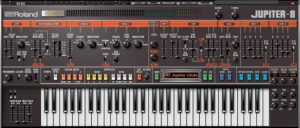
Jupiter-8
Stores and Prices
| Store | Product Name | Price | List Price | Discount | Sale Ends |
|---|---|---|---|---|---|
| kvraudio | Jupiter-8 | $ 99.00 | $ 199.00 | -50.3% |
Price History
| Date & Time | Price | List Price | Discount | Sale Ends |
|---|---|---|---|---|
| 2026-08-14T00:23:07.939588+00:00 | $ 99.00 | $ 199.00 | -50.3% |
Reviews
[Review] Roland Cloud JUPITER-8: The Ultimate Emulation That Perfectly Reproduces the "King's Sound" That Dominated the 80s
Rating: 4.5 / 5.0
The "JUPITER-8" offered by Roland Cloud's official website is a plugin that officially recreates Roland's top-of-the-line analog polyphonic synthesizer, released in 1981 and featured in countless hit songs by artists like Duran Duran, as software. [cite: 1.1.5, 1.1.9]
Using Roland's proprietary "ACB (Analog Circuit Behavior) technology," it models the behavior of the original analog circuitry with astonishing precision at the component level. [cite: 1.1.3, 1.1.9] Furthermore, as a software-exclusive extension, it achieves more polyphony than the hardware unit, enabling more complex and richer compositions. [cite: 1.1.1, 1.1.3]
In this article, we place maximum weight on evaluations from KVR Audio Forum, Reddit, Gearnews, and other specialized media, as well as thorough verification videos on YouTube, to review the true capabilities of this product compared to strong competing clones such as Arturia and TAL Software. [cite: 1.1.6, 1.1.9]
1. Evaluation Trends Across Communities, Platforms, and Specialized Media
The software version of the JUPITER-8 is the "ultimate holy grail" for synthesizer enthusiasts worldwide, and the community is always engaged in heated debates comparing it with other companies' emulations. [cite: 1.1.9]
- Comparison discussions on KVR Audio Forum / Reddit:
- The most frequently compared plugins in the community are Arturia's "Jup-8 V" and TAL's "TAL-J-8". [cite: 1.1.6, 1.1.9] On the KVR forum, there are meticulous criticisms of the Arturia version, such as "the maximum LFO rate is only 20Hz, unlike the hardware (40Hz), so there are limitations in reproducing string-like patches using PWM" and "the sweet spot is narrow." [cite: 1.1.6] On the other hand, the Roland Cloud version is highly praised for being "exactly as accurate as the hardware," from LFO behavior to sync tones. [cite: 1.1.6]
- Regarding TAL-J-8, it is supported on Reddit and elsewhere for its "good CPU efficiency and excellent dual-layer functionality," but the community consensus is that "if you want to produce 'exactly the same sound' as the original 1981 hardware, Roland's official ACB modeling is the most convincing." [cite: 1.1.9]
- Specialized media such as Gearnews:
- A Gearnews review praises it as "one of the most convincing emulations on the market." [cite: 1.1.9] In particular, it is noted that the reproduction of the JUPITER-8's signature "complex evolving pads" and "crystalline percussive tones" is perfect. [cite: 1.1.9]
- A/B tests with the hardware on YouTube:
- In thorough blind tests by renowned synth YouTubers such as Starsky Carr, comparing "hardware vs. plugin," it has been demonstrated that the Roland Cloud version reaches a level almost indistinguishable from the hardware in terms of filter resonance screams and oscillator cross-modulation behavior.
2. Main Modules and Architecture
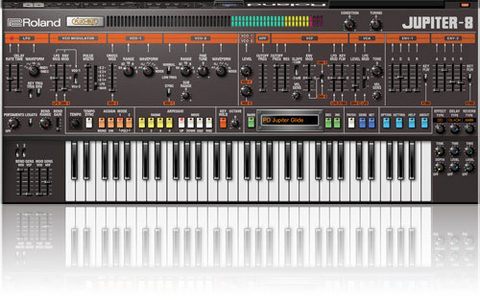
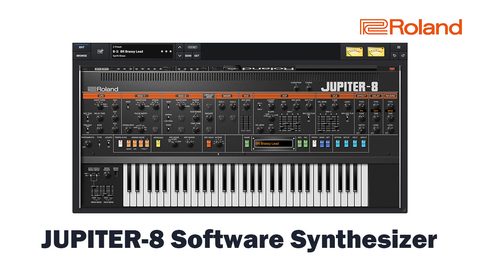
The beautiful panel layout of the JUPITER-8, which is not overly complex yet allows deep sound design, is faithfully reproduced in the software. [cite: 1.1.3]
| Module Type | Features and Community Evaluation |
|---|---|
| 2 VCOs | Two oscillators with an extended frequency range. [cite: 1.1.5] The intense sync leads and metallic cross-modulation are vividly reproduced by ACB. |
| VCF (Filter) | Equipped with a resonant low-pass filter with switchable slope and a high-pass filter. [cite: 1.1.5] Its creamy, warm analog feel is top-class in the software world. [cite: 1.1.5] |
| Arpeggiator | The iconic arpeggio patterns heard in Duran Duran's "Rio" and others. [cite: 1.1.9] It automatically syncs to the DAW's tempo, offering greater convenience than the hardware. [cite: 1.1.7, 1.1.9] |
| Condition Knob | Accessible from the hidden panel, this knob allows you to adjust the synthesizer's character from a pristine, clean state to a warm, unstable, aged (ultra-vintage) state. [cite: 1.1.3, 1.1.5] |
3. Sound Quality: The "King's Presence" That Dominates Tracks
The sound of the JUPITER-8 exudes a "special presence" among the many vintage synthesizers. [cite: 1.1.9]
- Thick brass and unison leads: Using the "Unison" function, which stacks all 8 voices onto a single note, produces monster-grade lead and bass sounds that overwhelm speakers. [cite: 1.1.9]
- Rich, expansive pad sounds: When playing polyphonic chords across different octaves, the subtle detuning of the oscillators and the glide (portamento) create a rich, organic resonance that is beautiful and hard to achieve with other plugins. [cite: 1.1.9]
4. Usability and System Load (Cloud Friction)
- The price of ACB technology (high CPU load): Because it performs perfect modeling at the circuit level, the CPU load is significantly higher compared to competitors like TAL-J-8. [cite: 1.1.9] When fully utilizing the extended polyphony to play chords, you may feel the load even on modern PCs. [cite: 1.1.1, 1.1.3]
- Dependence on the Roland Cloud Manager: A recurring issue on KVR and Reddit is the subscription model and dependence on the Roland Cloud app. [cite: 1.1.6] For users who prefer offline use or the simplicity of a one-time purchase, this is the biggest barrier to adoption. [cite: 1.1.6]
- Hardware integration: The PLUG-OUT function for compatible Roland hardware (such as SYSTEM-8) allows full tactile control without a PC, which is highly regarded as a major benefit. [cite: 1.1.3, 1.1.9]
Pros and Cons Summary
Pros
- Ultimate "hardware sound": Compared to Arturia and others, the modeling is overwhelmingly accurate in terms of LFO range and sync behavior. [cite: 1.1.6, 1.1.9]
- Condition knob: Perfectly simulates the "analog drift" caused by individual differences and aging. [cite: 1.1.3, 1.1.5]
- Extended polyphony: Allows richer chord playing beyond the hardware's 8-voice limit. [cite: 1.1.1, 1.1.3]
- PLUG-OUT support: Integrates with compatible hardware to achieve a hands-on feel akin to the original. [cite: 1.1.3, 1.1.9]
Cons
- Higher CPU load compared to competitors: Resource consumption is extremely high compared to lightweight clones like TAL-J-8. [cite: 1.1.9]
- Roland Cloud system friction: Resistance to the always-on app and online authentication. [cite: 1.1.6]
- Large GUI: Compared to TAL-J-8's dual-panel layout, preferences for panel visibility may vary. [cite: 1.1.9]
Overall Review: The Ultimate Answer to Get the "True Sound of 1981" Without Compromise
The Roland Cloud JUPITER-8 is not a plugin that competes on "light CPU usage" or "many modern conveniences." [cite: 1.1.9] As the community demonstrates, the value of this plugin lies in its absolute supremacy in one single aspect: "playing the true sound of the world's most famous analog polysynth in your DAW." [cite: 1.1.9]
Even though excellent alternatives like TAL-J-8 and Arturia Jup-8 V exist, for producers who want to imprint "the authentic sound at the circuit level by Roland, the original designer," there is no better choice. [cite: 1.1.6, 1.1.9]
[Tips] Roland Cloud JUPITER-8: Squeeze the Analog King to the Limit
The Roland Cloud JUPITER-8 is a plugin that completely recreates the legendary analog polysynth at the component level using ACB (Analog Circuit Behavior) technology. Here are some hardcore tips researched in overseas communities to push the hardware's limits, going beyond mere 80s retro sound reproduction.
1. Audio-Rate FM via Cross Modulation (X-MOD)
The JUPITER-8 is a pure analog synth, but it features a powerful "cross modulation" function where VCO-1 modulates VCO-2. * Creating metallic industrial tones: Set VCO-1's waveform to triangle or sine and set its pitch extremely high. Apply this deeply to VCO-2 (e.g., sawtooth) via X-MOD. You can build cold, hard bell sounds like a DX7 or aggressive FM basses with dissonance while maintaining the thickness of an analog synth.
2. The Devilish Combination of the Condition Knob and Unison Mode
A major privilege of the Roland Cloud version is the "Condition" knob, which simulates circuit aging (tuning instability). * Extreme pitch drift and phase undulation: Set the Condition knob to maximum (most aged state) and set the voice mode to "Unison." With up to 16 oscillators whose pitches are randomly fluctuating, they interfere with each other, instantly creating unstable, thick drone pads full of intense nostalgia and madness, like Boards of Canada.
3. Fine Detuning and Stereo Separation in Dual Mode
Use the "Dual" mode, a hallmark of the JUPITER-8 that layers two patches, for spatial processing. * Ultra-thick stereo without relying on chorus: Load the exact same brass or strings patch into Upper and Lower. Detune the Lower side's VCO pitch or filter cutoff by "just a hair" (a value of 1-2). By hard-panning these left and right via DAW routing or plugin settings, you create a cinematic sound with overwhelming stereo width derived from the physical discrepancies of analog circuits, which cannot be achieved with effect choruses.
4. Adding Nasty Transients with Inverted ENV-1
Apply the 80s-standard laser sound creation using the pitch-dedicated envelope (ENV-1) to bass making. * Click attack that cuts through the mix: When creating synth bass, set ENV-1's decay to almost zero (shortest) and assign a tiny amount of modulation to the VCO pitch. The pitch drops extremely fast only at the moment you press a key, adding a strong "click" attack (transient). This gives analog basses, which tend to get buried, a sharp contour that can compete with modern kick drums.