Reviews
Review: KORG TRITON: The "King of Workstations" That Dominated 2000s Hip-Hop and R&B
Rating: 4.7 / 5.0
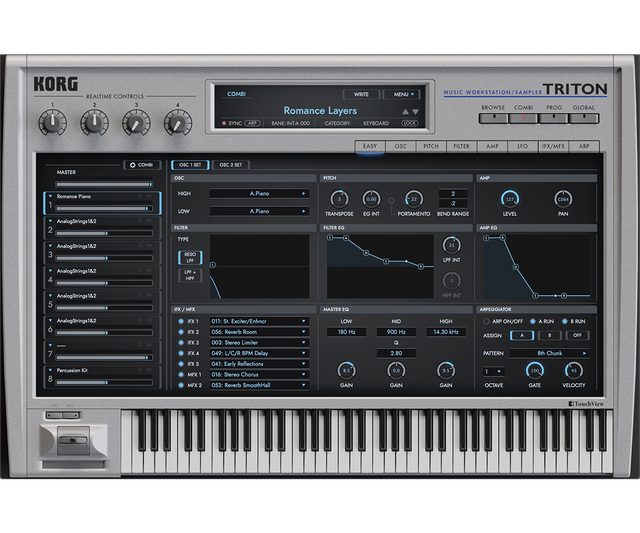
The KORG TRITON is a complete software emulation of the monster workstation released in 1999 that dominated the charts of the 2000s. It brings the "HI (Hyper Integrated) Synthesis System"—beloved by top producers like The Neptunes and Timbaland—back to life in your DAW.
In this article, we thoroughly review how this hardware, which once cost thousands of dollars, functions as a plugin with all expansion boards (EXB-PCM) included, based on evaluations from Gearspace, Reddit, and YouTube beat-making communities.
1. Evaluation Trends Across Communities, Platforms, and Specialized Media
The TRITON is not just a vintage synth; it is praised for its overwhelming nostalgia and practicality as a "soundtrack of a specific era."
- Reddit Discussions (r/makinghiphop, r/synthesizers): On Reddit, it is frequently lauded as the "magic box of early 2000s hip-hop and R&B." Users say, "Sometimes you need the lo-fi, punchy TRITON guitars and bells from back then, not the high-resolution sample libraries of today," and they value its unique character.
- Gearspace Media Reviews: Producers on Gearspace find the greatest value in the fact that all the "EXB-PCM expansion boards" (including the TRITON Extreme version), which were expensive and hard to obtain during the hardware era, are included from the start. Many voices say, "It's a miracle to get the full set for a few tens of thousands of yen."
- YouTube Reviews: In beat-making videos on YouTube, demos of the dual arpeggiator are popular. The sight of simply selecting a preset and holding a chord to instantly create the skeleton of a 2000s club banger impresses many young producers.
2. Main Modules and Architecture
| Module Type | Features and Community Evaluation |
|---|---|
| HI Synthesis Engine | KORG's proprietary engine combining high-quality PCM waveforms and filters. Simple by modern standards, but boasts a sound that cuts through the mix exceptionally well. |
| All Expansion Boards Included | Covers all EXB-PCM boards (thousands of presets) providing a vast array of additional waveforms, from trance to orchestral. |
| Dual Polyphonic Arpeggiator | A powerful arpeggiator that can simultaneously generate drum patterns, basslines, and complex cuts—a cornerstone of music production back then. |
| Insert & Master FX | Over 100 effects built-in. The powerful routing of this effects section enhances the completeness of the TRITON sound. |
3. Sound Quality: The "Million-Dollar Sound" of the 2000s
Summarizing community opinions, the TRITON's sound is described as "dated but musically perfect."
- Golden Age of Hip-Hop and R&B: The cheap yet punchy acoustic guitars, icy synth bells, and fat orchestral hits have an appeal like "sampling material" that can be immediately used in modern trap or lo-fi hip-hop.
- Mix-Ready Texture: Compared to modern multi-gigabyte libraries, the waveforms are smaller, but they are well-organized in frequency bands, and professional engineers highly appreciate that they fit neatly into a track without excessive EQ processing.
4. Usability, System Load, and Requirements
- Amazing CPU Efficiency: Since it was originally 1999 hardware, the plugin's CPU load is extremely low. You can run dozens of instances in a huge project without any issues on a modern PC.
- Easy Browsing: Being freed from the small LCD screen of the time and being able to instantly search thousands of presets with a refined software browser is welcomed by all users as the "biggest upgrade."
Pros and Cons Summary
Pros * Definitive 2000s Sound: Perfectly recreates the hip-hop and pop of that era. * All Expansion Boards Included: The immensely valuable EXB-PCM expansions are available from the start. * Ultimate Low CPU Load: Add countless instances to your tracks without worrying about resources. * Dual Arpeggiator: One-finger inspiration for song ideas.
Cons * Lo-fi by Modern Standards: Not suitable for those seeking ultra-realistic orchestral sounds. * KORG Software Pass: Complaints about the usability of the license management software common to KORG products.
Overall Review: The "Ultimate Time Machine" for Modern Beat Makers
The KORG TRITON is not just a reissue of a synthesizer; it is the ultimate time machine that brings the "magical workstation" that dominated the 2000s music industry into your DAW.
It sits at the opposite pole from the latest ultra-realistic libraries, but as the community proves, its "intentionally organized, punchy lo-fi texture" is actually a powerful weapon in modern beat making. For producers making trap, R&B, or nostalgic pop, there is no plugin that can be a more immediate asset.
Tips: Practical Techniques to Get the Most Out of the KORG TRITON / TRITON Extreme
The KORG TRITON and TRITON Extreme plugins are feature-packed monster synthesizers. Here are practical tips and workflows used by producers and YouTube beat makers worldwide to unlock 120% of this plugin's potential in a DAW environment.
1. Ultimate Layering & Splits in Combi Mode
One of the TRITON's greatest strengths is "Combi (Combination)" mode, allowing you to layer up to 8 programs (sounds).
- Create Thick 2000s Hip-Hop Brass: If a single brass (in Prog mode) sounds thin, layer 3-4 different brass and strings in Combi mode, spread their pan left and right, and detune them. Instantly, you get a "Timbaland-style" fat orchestral hit.
- Velocity Switching: Set velocity zones so that a different sample (e.g., an orchestral hit or guitar scratch) sounds only when you play hard, adding dramatic dynamics to your performance.
2. Valve Force (Vacuum Tube) Gain Staging (Extreme Version Only)
The "Valve Force" on the TRITON Extreme plugin is not just an on/off switch.
- Adjust Input Gain: By raising the "Input Trim" before the signal passes through the tube circuit, you can achieve pleasant analog saturation or drive.
- Create Lo-fi Drums: Run a too-clean drum loop through the TRITON, crank the Tube Gain on Valve Force to the max, and you can pseudo-create punchy lo-fi drums in your DAW, as if passed through a sampler (MPC or SP-1200).
3. Polyrhythmic Use of the Dual Arpeggiator
The TRITON's arpeggiator can run two "systems" (A and B) simultaneously.
- One-Person Band via Splits: Assign a bass (Arp A) to the left half of the keyboard and a synth pluck (Arp B) to the right half. With one finger, you can generate completely different rhythmic basslines and melodies at the same time, instantly creating a track's skeleton.
- Use the Latch Function: Turn on the arpeggiator's Latch and play a chord; the sequence will keep looping even after you take your hands off the keys. Meanwhile, automating effect and filter parameters in real time is a classic electronic music production technique.
4. Serial Routing of Insert Effects (IFX)
The secret to the TRITON's thick sound lies in the routing of its powerful insert effects (up to 5 chains).
- Effect Chaining: In the IFX routing screen, connect effects in series, e.g., IFX1 (compressor) → IFX2 (EQ) → IFX3 (stereo chorus), to create fully "mix-ready" patches entirely within the TRITON without external plugins.
- Use BPM Delay: Set the effect's delay time to "MIDI Sync" to follow your DAW's BPM, making it easy to build rhythmic delays essential for trance or EDM.
5. Multi-Output (Para Out) Setup for DAW Mixing
When using Combi mode to play drum kits or multiple instruments, outputting everything in stereo 2ch makes mixing in the DAW difficult.
- Use Individual Outs: In the TRITON's routing screen (Routing / IFX), assign the kick, snare, hi-hat, or bass and leads to individual outputs like "1/2, 3/4..." instead of "L/R." Create multi-output tracks in your DAW, allowing modern mixing techniques such as applying a dedicated compressor to the kick or high-quality external reverb to the lead.
6. Efficient Browsing and Searching
Here's how to manage the overwhelming number of presets without getting lost.
- Filter by Expansion Board (EXB-PCM): Use the bank selection at the top of the browser to narrow down to specific expansion boards like "EXB-PCM," making it quick to find sounds for a particular genre (e.g., "Vintage Archives" or "Trance Attack").
- Favorite Registration: The TRITON has so many sounds that you should always star (favorite) any "usable sound" you stumble upon. If you neglect this, you'll become a "preset wanderer," never finding the same sound again.