Reviews
[Review] KORG Modwave Native: A "Otherworldly Dynamic Modulation" Synth Where Kaoss Physics and Wavetables Converge
Rating: 4.7 / 5.0
The "Modwave Native" from KORG is a complete software edition of the hardware synthesizer "Modwave," which inherits the lineage of the legendary 1985 "DW-8000" while fusing state-of-the-art wavetable synthesis with groundbreaking physics-based modulation.
Its standout features are "Kaoss Physics," which simulates ball bounces and friction to generate unpredictable modulation, and "Motion Sequencing 2.0," which loops timing and pitch independently. These allow you to effortlessly create complex, dynamic sounds that are constantly in motion—something unimaginable from static waveforms.
This article focuses on evaluations from KVR Audio Forum, Reddit, Gearspace, Sound On Sound, and YouTube synthesizer communities, thoroughly reviewing what unique value this plugin offers amidst strong competitors like Pigments and Serum.
1. Evaluation Trends Across Communities, Platforms, and Specialized Media
Modwave Native is praised as one of the strongest options in the modern wavetable plugin market, going beyond a mere hardware port.
- Gearspace / Sound On Sound Media Reviews: Professional reviews on Gearspace and Sound On Sound praise the innovation of "Kaoss Physics." They describe it as "able to intuitively create organic, chaotic modulation that traditional LFOs or envelopes could never produce," earning high support from film and game music composers.
- Reddit (r/synthesizers, r/edmproduction) Discussions: On Reddit, comparisons with Serum and Pigments are frequent. A common assessment is that "Compared to Serum's usability or Pigments' visual beauty, Modwave has KORG's characteristic ruggedness, but in terms of aggressive sound output and the ability to build complex rhythms with Motion Sequencing, Modwave is overwhelmingly sharper."
- YouTube Reviews (Loopop, Starsky Carr, etc.): Tutorial videos showcase the extensibility of drag-and-drop importing of Serum-compatible custom wavetables, as well as destructive sound design demos combining a vast array of effects with MS-20 filters.
2. Key Modules and Architecture
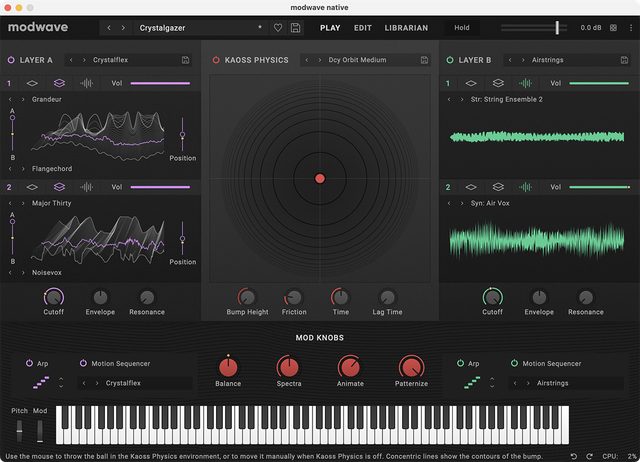
Modwave Native features two complete layer structures (Layer A / Layer B) and an unparalleled modulation engine.
- Dual Wavetable Oscillators: Each layer is equipped with two oscillators. With over 200 high-resolution wavetables, plus more than 30 types of modifiers and 13 morph types, waveforms can be infinitely transformed.
- Kaoss Physics: A revolutionary controller where you roll a ball in a virtual space, using its position and velocity as modulation sources. Adjust tilt, friction, and restitution to create organic fluctuations.
- Motion Sequencing 2.0: Inherited from Wavestate, this sequencer runs timing, pitch, shape, and other parameters on independent lanes, enabling complex polyrhythms and arpeggios.
- Diverse Filters and Built-in FX: Includes the aggressive MS-20 lowpass/highpass, smooth Polysix filter, plus three studio-grade effects per layer and master reverb/EQ.
3. Sound Quality: From Fierce Basses to Ethereal Cinematic Pads
Summarizing community opinions, the sound is "hard, clear, and surprisingly dynamic."
- Overwhelming Modern Dance Sounds: Combining wavetable modifiers with aggressive filters instantly produces metallic, cutting, ultra-thick basses and leads that can take center stage in drum and bass or dubstep.
- Organically Breathing Ambient Pads: Pad sounds that subtly fluctuate via Kaoss Physics never feel looped, making them perfect for long cinematic drones or background textures in scoring.
4. Usability, System Load, and Requirements
- Comfortable Editing on a Large Screen: Compared to the hardware's small display, the software version shows all wavetables, sequence lanes, and physics parameters on a huge screen, dramatically improving workflow efficiency.
- KORG Software Pass and UI Density: As with other KORG Native series, there are some complaints about the authentication app's usability, and the sheer number of modulation parameters requires a learning curve to master fully.
Pros and Cons Summary
Pros * Originality of Kaoss Physics: Unpredictable, organic modulation via physical simulation. * Motion Sequencing 2.0: Easily build complex polyrhythms and time-varying changes. * High Extensibility: Supports importing user wavetables and samples in Serum format, etc. * Full Hardware Compatibility: Seamless bidirectional patch transfer with the physical Modwave. * Punchy Sound: Sharp, thick tones from MS-20 filters and numerous modifiers.
Cons * Information-Dense UI: Many parameters on screen due to high functionality, which can overwhelm beginners. * KORG Software Pass Usability: License management and initial authentication processes have room for improvement.
Overall Review: A Top-Tier Monster Embodying the Evolution of Wavetable Synthesis
KORG Modwave Native is a masterpiece that establishes a strong identity with "Kaoss Physics" and "Motion Sequencing 2.0" in the saturated wavetable synth market.
As recognized by specialized media and creators worldwide, it excels not only in sound quality but also in its ability to "give life and motion to sound," unmatched by other synthesizers. From producers crafting EDM hits to film composers seeking moving soundtrack textures, this is a powerful plugin that meets the expectations of all sound creators.
[Tips] Practical Techniques to Get the Most Out of KORG modwave native
KORG modwave native is a monster plugin that revives the concept of the legendary 1985 DW-8000 for the modern era, adding intense wavetable synthesis and Motion Sequencing 2.0. Here are community-driven practical tips to unleash 120% of this synth's potential in your DAW environment.
1. Importing Custom Wavetables (e.g., Serum)
The true value of modwave native lies not only in its vast built-in waveforms but also in its ability to load external waveforms. * Utilize Serum or Vital Wavetables: Easily import third-party wavetables in .wav format designed for Serum or Vital. Load cutting-edge bass waveforms created in Serum and animate them with modwave's powerful modulation or Kaoss Physics to create complex bass music patches unavailable in other synths.
2. Building Polyrhythms with Motion Sequencing 2.0
Motion Sequencing 2.0, an evolution of traditional step sequencers, allows independent looping of each element. * Change Loop Length per Lane: Intentionally set different step counts for the "Timing," "Pitch," "Shape," and "Seq" lanes (e.g., Pitch at 16 steps, Timing at 15 steps). This creates unpredictable polyrhythmic phrases where accents and melodies subtly shift with each loop—ideal for IDM or ambient music.
3. Linking Kaoss Physics with Wavetable Position
The "Kaoss Physics" feature, which uses the physical behavior of a bouncing ball as modulation, pairs exceptionally well with wavetables. * Simultaneous Modulation of Multiple Parameters: Assign the X-axis of Kaoss Physics to OSC1's Wavetable Position and the Y-axis to OSC2's Wavetable Position (or Filter Cutoff). Simply flicking the ball creates complex, organic, and random sweeps of two waveforms. By controlling the trigger timing via DAW automation, you can synchronize chaotic movements perfectly with your track.
4. A/B Blend Within a Single Oscillator
modwave allows combining two different wavetables (A and B) within one oscillator. * Real-Time Morphing: Set a digital waveform with a sharp attack on one side and a soft analog waveform on the other, then modulate the "A/B Blend" parameter with an LFO or envelope. This creates rich, complex layered sounds with time-varying changes without consuming two oscillators.
5. The Magic of Digital Waveforms + Vintage Filters
The combination of cold, sharp digital wavetable sounds with KORG's renowned analog-modeling filters is superb. * Drive the MS-20 / Polysix Filters: Create highly digital, metallic waveforms in the OSC section and route them through the modeled "MS-20 Lowpass" or "Polysix" filters. Slightly increasing the filter's Drive adds analog circuit saturation and warmth to the digital coldness, resulting in leads and pads with overwhelming presence in the mix.