Reviews
Review: u-he Zebra 3 – Redefining Deep Synthesis, the Long-Awaited Modular Masterpiece
Rating: 4.8 / 5.0
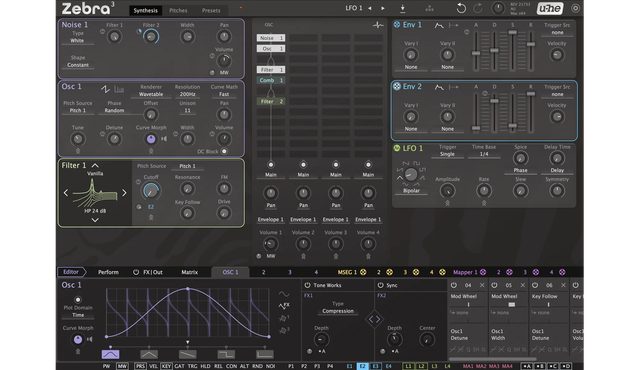
After more than a decade of active development and endless anticipation from the community, u-he's "Zebra 3," released in April 2026, has finally established itself as the definitive flagship modular synthesizer. u-he has gone beyond a simple update of its predecessor, rebuilding this monster from scratch, fusing analog modeling, physical modeling, and extremely pure digital synthesis into a staggering ecosystem.
This article places the greatest weight on the massive wave of reviews and discussions that erupted on the KVR Audio Forum, Reddit, and prominent YouTube channels following this long-awaited release, dissecting the true philosophy, features, and controversies of this deep sound design lab.
1. Evaluation Trends Across Community Platforms
The arrival of Zebra 3 sent shockwaves through the synth community, with discussions largely centering on "sound design philosophy" versus "practicality."
- KVR Audio Forum: On KVR, sound designers celebrate the infinite possibilities of the new engine, praising its ability to create "sounds you could never get from a standard wavetable synth." However, the most controversial topic is the "lack of full backward compatibility with Zebra 2 presets." Although u-he had warned about this architectural change in advance, long-time users express frustration over losing decades of past patch assets.
- Reddit (r/synthesizers, r/edmproduction): Reddit users frequently compare Zebra 3 with synths like Serum. The consensus is clear: "If speed is your goal, Zebra 3 is not for you. If deep, complex sound design is your goal, nothing else comes close." Starting from a "completely blank slate," where you must manually route oscillators and filters, encourages out-of-the-box thinking but significantly slows down quick beat-making workflows.
- YouTube Reviews (e.g., AREFYEV Studio): Video reviewers highlight the new context-aware UI and the instrument's overwhelming scale. While the interface is clean and beautifully color-coded, all reviewers unanimously warn of a "considerable learning curve," describing it as a professional tool for dedicated sound designers rather than a mass-market preset player.
2. Key Modules and Architecture
Zebra 3 requires users to approach it as a "true modular setup where the wiring is invisible," offering unparalleled customization.
- Spline-Based Oscillators: Praised as a true "Swiss Army knife." Instead of standard wavetables, users manipulate splines to surgically shape waveforms, resulting in cleaner, more complex harmonic output.
- Physical Modeling Generators: A major highlight for the community. They can perfectly mimic organic acoustic instruments, providing the ultimate playground for creating experimental cinematic textures.
- Versatile Filter Bank: Offers a staggering variety of creative filters that go far beyond standard analog emulations, providing endless means to sculpt and distort signals.
- Context-Aware UI: An interface that intelligently displays controls only when needed. While praised for reducing visual noise, the community notes it remains intimidating for beginners due to the lack of an "easy mode."
3. Sound Quality: Perfect Musicality and Organic Depth
Summarizing community reactions, Zebra 3 has an "incredibly huge sweet spot," making it surprisingly difficult to produce truly bad sounds.
- Pure, Uncompromising Audio: Users are overwhelmed by its sheer audio fidelity. Whether crafting glitchy electronic sequences or massive analog-style basses, the underlying sound engine is breathtakingly musical, with no harsh digital artifacts.
- A New Standard for Cinematic: As with its predecessor, Zebra 3 is immediately recognized as the ultimate tool for film composers. The organic nature of physical modeling blends perfectly with real orchestral instruments, carrying on the legacy of Hans Zimmer.
4. Usability and System Load/Requirements
- Workflow Trade-off: The flexibility of adding oscillators and modulators yourself is a double-edged sword. While highly rewarding for deep exploration, it is widely criticized as "too slow for real deadlines."
- High CPU Load: Unlike the very lightweight Zebra 2, Zebra 3 is a demanding monster. Running high-resolution oscillators and complex physical modeling requires modern processing power, sparking controversy among users with older machines.
Pros and Cons Summary
Pros * Unbeatable Modular Architecture: Infinite patching flexibility starting from a blank slate. * Superb Sound Quality: Spline-based oscillators and physical modeling sound remarkably organic. * Over 1,200 Factory Presets: A massive library showcasing the new engine's overwhelming depth. * Context-Aware UI: Clean, color-coded UI that intelligently manages extreme complexity.
Cons * Lack of Backward Compatibility: Zebra 2 presets cannot be loaded into the Zebra 3 engine. * High CPU Load: Resource consumption has jumped significantly compared to its predecessor. * Steep Learning Curve: Not suitable for quick beat-making due to the lack of an "easy mode" and slower workflow.
Overall Verdict: A Professional Lab for Dedicated Sound Designers
u-he Zebra 3 is not just a synth for quickly punching in pop chord progressions. As the community widely agrees, it is "a professional lab for those who want to sculpt completely unique sounds from scratch."
It demands a significant investment of time, patience, and processing power. However, for film composers, avid sound designers, and musicians willing to master new modular signal paths, Zebra 3 opens up an acoustic universe that no other synthesizer on the market can reach.
Tips: u-he Zebra 3 Ultimate Sound Design
u-he Zebra 3 (and the oscillator section of the earlier Zebralette 3) is a next-generation modular workstation boasting spline-based waveform editing and intense modulation capabilities. Here are advanced, nerdy tips researched in international communities like the KVR forum.
1. Fusion of Spline Waveforms and Audio-Rate MSEG
The biggest weapon of Zebra 3 is the ability to draw waveforms with free Bézier curves (splines). * The Pinnacle of Self-Modulation: Apply a completely different MSEG (multi-stage envelope) at audio rate (audible speed) to your custom spline waveform. This causes only parts of the waveform to distort rapidly, producing aggressive sounds akin to localized FM or phase distortion. * Dynamic Point Modulation: Instead of morphing the entire waveform, modulate only a single control point with an LFO or velocity. This allows for raw vowel changes or organically wriggling textures.
2. Chaotic Multi-Stage Routing of Spectral Effects
Go beyond simple wavetables with advanced real-time spectral editing. * Stacking Fractal and Phase Distortion: In the oscillator's spectral effect slots, chain the "Fractal" module and "Phase Distortion" in series. * Noise LFO as Modulator: Feed an LFO set to a noise waveform at audio rate into the effect parameters. This instantly creates metallic, unpredictable alien basses or glitch textures typical of sci-fi films.
3. Nonlinear Curve (Mod Mapper) Processing of Modulation Signals
Editing and transforming the modulation signals themselves (like LFOs) is the Zebra way of sound design. * Passing Through Modifiers: Instead of sending LFO or envelope signals directly to the target parameter, route them through a "Mod Mapper" (curve modifier) first. * Generating Quantized Modulation: Force the smooth input LFO signal into a stepped (quantized) curve within the Mod Mapper. Sending this to filter cutoff or pitch easily generates rhythmic, glitchy sequences reminiscent of hardware sample-and-hold or quantizers.