Reviews
[Review] Cherry Audio GX-80: The Ultimate Cinematic Vintage Synth Fusing the Legendary "GX-1" and "CS-80"
Rating: 4.8 / 5.0
The "GX-80" developed by Cherry Audio is an unprecedented flagship software synthesizer that fuses the circuits and features of the legendary analog synthesizer "Yamaha CS-80," beloved by Vangelis, with its predecessor, the ultra-rare "Yamaha GX-1," often called the "Dream Machine."
Going beyond a mere CS-80 emulation, it incorporates GX-1-specific oscillator waveforms and filter designs, additional octave voices, and two completely independent layer structures. By achieving all this at an overwhelming cost-performance ratio, it has garnered enthusiastic support from the global synthesizer community immediately after its release.
In this article, we place the greatest weight on evaluations and discussions from KVR Audio Forum, Reddit, and YouTube synthesizer specialist channels, and thoroughly review the true capabilities of this product compared to competitors such as Arturia CS-80 V.
1. Evaluation Trends Across Community Platforms
The GX-80 has received immense praise from the community for its "overwhelming sonic persuasiveness" and "incredibly low price."
- Comparative Discussions on KVR Audio Forum: On the KVR forum, detailed comparisons with Arturia's "CS-80 V" are frequently conducted. Many users evaluate that "while the Arturia version is also refined, the GX-80 is overwhelmingly more authentic in terms of the 'organic weight' produced by the stickiness of the mid-low range and the interaction of the high-pass/low-pass filters." Additionally, the flexibility to combine GX-1 voice structures is highly praised as a "one-of-a-kind hybrid experience."
- Discussions on Reddit (r/synthesizers, r/AudioPlugins): On Reddit, the evaluation "Cherry Audio's greatest masterpiece" has become established. In particular, full support for polyphonic aftertouch and MPE (MIDI Polyphonic Expression) is highly regarded, with enthusiasts saying, "When combined with the latest expressive controllers like Osmose or LinnStrument, the sound of the movie 'Blade Runner' is completely revived on the spot."
- YouTube Reviews (Starsky Carr, Tim Shoebridge, etc.): In verification videos by well-known synthesizer reviewers on YouTube, the behavior of the ribbon controller unique to the original hardware and the overwhelming stereo image when layering two independent layers (Ranks) are demonstrated. Many reviews conclude, "It's an industry event that a synth of this quality is available for under $100."
2. Main Modules and Architecture
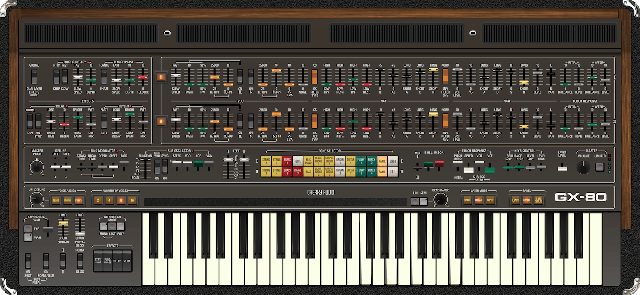
Based on the intuitive slider operation of the CS-80, the monster-class features of the GX-1 are seamlessly integrated.
| Module Type | Features and Community Evaluation |
|---|---|
| Dual Layer Structure | Each of the upper (Rank 1) and lower (Rank 2) sections has a completely independent full synth engine. With split or layer, you can build insane stacked sounds with up to 16 voices. |
| CS-80 & GX-1 Hybrid OSC | In addition to standard pulse and sawtooth waves, it features GX-1-specific triangle pulse and octave up/down waveforms, generating unique harmonics not possible with typical subtractive synths. |
| Serial Dual Filters | A 12dB/oct high-pass filter and low-pass filter are placed in series. The unique "vowel-like resonance" obtained by sandwiching the band is perfectly reproduced. |
| Ribbon Controller & MPE | A ribbon controller for smooth pitch bend and filter modulation is placed at the bottom of the screen. With polyphonic aftertouch, independent vibrato expression per key is possible. |
3. Sound Quality: Complete Reproduction of "That Brass and Lead" That Adorned Film History
Summarizing community opinions, the sound of the GX-80 has an "overwhelming cinematic scale."
- Iconic Blade Runner Brass: The legendary synth brass, where the filter opens with aftertouch and rich vibrato naturally follows, boasts a perfection that gives you goosebumps with just one note.
- Crystal Tones Derived from the GX-1: By utilizing the GX-1's oscillator modes, it covers sound ranges impossible with typical CS-80 clones, such as sharp percussive organ sounds and brilliant yet somewhat melancholic lead sounds.
4. Usability, CPU Load, and UI Challenges
- Intuitive but Information-Dense UI: Since it follows the original hardware layout centered on sliders, the overall picture of parameters is easy to grasp at a glance. On the other hand, because two layers plus an effects section are lined up, the screen is filled with sliders, and on small monitors like laptops, it takes some getting used to for visibility.
- Amazing CPU Optimization: Despite simultaneously running two huge analog circuits and high-quality effects (chorus, rotary, delay, reverb), the CPU load is very well optimized, and it runs smoothly even when multiple instances are opened in a project.
Pros and Cons Summary
Pros
- A one-of-a-kind sound engine fusing the CS-80 and GX-1.
- Filter behavior and analog texture indistinguishable from the real thing.
- Full support for polyphonic aftertouch and MPE.
- Overwhelming cost-performance (disruptive pricing).
- High-quality built-in effects and intuitive ribbon controller.
Cons
- Dense slider UI: Many controllers on screen, slightly difficult to operate on small displays.
- Quirks of the original hardware: It takes getting used to the Attack/Decay-based envelope design rather than typical ADSR.
Overall Review: An Essential Instrument for All Musicians Who Love Cinematic Sound
The Cherry Audio GX-80 is not just a revival of a vintage synth; it is a miraculous plugin that realizes the dream of "What if Yamaha had made a complete fusion of the GX-1 and CS-80?"
As the community's acclaim shows, its heavy, expressive analog tone is unparalleled in film music, synthwave, ambient, and progressive rock production. If you want to obtain incomparable expressiveness and sound quality at an affordable price, this is a masterpiece you should adopt without hesitation.
[Tips] Mastering the Legendary Deep Bass and Modulation on Cherry Audio GX-80
The Cherry Audio GX-80 is a dream plugin that fuses the legendary synthesizer "Yamaha CS-80," famous for Vangelis, with its phantom origin, the massive monster machine "GX-1." Here we introduce twisted and maniacal sound design tips explored by the overseas community, going beyond mere 'Blade Runner' sound reproduction.
1. Rhythmic Drones Using the Ring Modulator's Envelope (IL)
The ring modulator (Ring Mod), a hallmark of the CS-80/GX-80, is not just for creating bell-like metallic sounds. * Steep Descending Modulation with Envelope: The Ring Mod section has a dedicated envelope (IL). Set the MOD (LFO) speed extremely high, set IL's Attack to zero, and Decay short, moving the ring modulation frequency as if striking it down. This generates eerie percussive pulses independent of the oscillator pitch, or high-speed glitch drones like SF movie creatures.
2. Radical Assignments of MPE / Polyphonic Aftertouch
The GX-80 fully supports polyphonic aftertouch and MPE, which is the key to the "expressive like an acoustic instrument" quality of the original hardware. * Routing to Modulation Speed: Usually, aftertouch is assigned to VCF (filter) or VCA (volume), but try routing it to "Ring Mod speed" or "Sub Oscillator (LFO) speed." While playing a chord, pressing only certain fingers harder causes only those notes to tremble violently or modulate metallically, enabling extremely organic and chaotic performance expression.
3. Hybrid Layering of GX-1-Specific Waveforms and CS-80 Sine Wave
A major feature of the GX-80 is the ability to select "GX-1-unique waveforms" that do not exist on the CS-80. * Utilizing Filtered Waveforms: In the oscillator section of Rank I / II (layers), deliberately choose GX-1-specific "high-passed pulse waves" or "band-limited sawtooth waves" instead of CS-80 waveforms. Blend these with the pure "sine wave" characteristic of the CS-80 at the foundation, creating the ultimate hybrid brass that maintains thick analog low end while possessing a unique "glare" and "cut" that won't get lost in modern EDM mixes.
4. Vowel (Formant) Synthesis with Dual Filters (HPF + LPF)
Exploit the synth's unique filter structure where a high-pass filter (HPF) and low-pass filter (LPF) are placed in series. * Constructing a Pseudo Vocal Tract: Set both resonances quite high, raise the HPF cutoff a bit, and bring the LPF cutoff as close as possible to it (narrowing the band). In this state, moving both cutoffs simultaneously with Touch Response (aftertouch) or the ribbon controller causes the filter peaks to cross, producing formant sweeps like a human vocal tract where vowels (like "a" or "o") change smoothly.
5. Asymmetric Dual Layers and Separation of Ring Modulation
The GX-80 has two completely independent synthesizer layers: Upper / Lower (Rank I / II). * Vast Cinematic Stereo: Hard-pan Rank I to the left and Rank II to the right. Normally, the Ring Mod applies to the entire master output, but using the routing switches at the top of the panel, set it to apply "Ring Mod only to Rank II." From the left ear, pure and thick analog strings; from the right ear, metallic dissonance. This creates an abnormally wide and complex cinematic pad.