Reviews
Review: GForce Software impOSCar3: A Quirky British Classic Evolves into a "Wavetable Monster"
Rating: 4.7 / 5.0
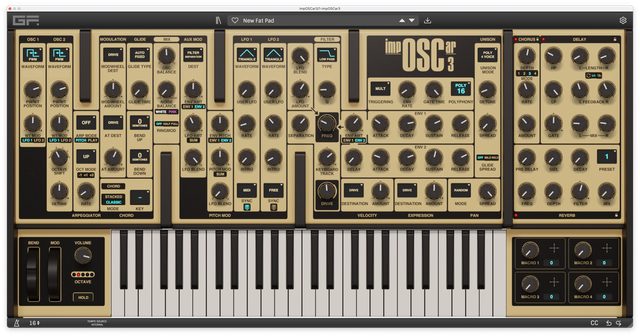
impOSCar3, developed by GForce Software, is the latest version of the highly acclaimed emulation of the legendary British hardware synthesizer, the OSCar. Version 3 introduces a full-featured wavetable editor, user LFO designer, macro controls, and a fully resizable UI, elevating this eccentric classic into a powerful modern tool. Placing the utmost weight on community feedback from KVR Audio, Reddit, and prominent YouTube reviewers, we explore how this hybrid beast bridges the gap between "raw analog warmth" and "precise digital additive synthesis."
1. Evaluation Trends Across Community Platforms
- KVR Audio Forum: On KVR, users consistently praise impOSCar3's unique architecture. It is highly regarded not just as an emulation, but as a deeply profound sound design tool. Many users emphasize that the combination of digital additive oscillators and warm analog filters produces an "acoustic character never achievable with everyday VSTs."
- Reddit and Synth Communities: The addition of the wavetable editor in version 3 has generated significant excitement. Reddit users point out that while the older version was ideal for classic 80s leads and basses, v3 has transformed it into an "ambient and cinematic giant." The ability to draw custom waveforms and manipulate them with the new macro knobs is widely discussed.
- YouTube Reviews: Video reviewers frequently focus on the iconic dual filter and the new "Poly Unison" feature. Demonstrations show how fine-tuning the "Separation" knob on the dual filter yields highly vocal, formant-like textures. Many reviewers describe the output when Poly Unison is enabled as an absolute "wall of sound."
2. Key Modules and Architecture
| Module Type | Features and Community Evaluation |
|---|---|
| Hybrid Oscillator | Fuses digital precision with a new wavetable engine. Users can draw harmonics in an additive synthesis style or use over 150 preset waveforms to create timbres unattainable with subtractive synths. |
| Unique Dual Filter | The undeniable star of this synth. With LP, HP, and BP modes, it features a "Separation" knob that splits the filter. It delivers everything from piercing highs to intensely driven lows. |
| User LFO and Envelopes | v3 introduces a dedicated LFO design panel. Reviewers love that you can design complex, rhythmic modulations in minutes without the need for full manual drawing. |
| Effects and Macros | Four programmable macros and a gorgeous matrix reverb have been added. These enable infinite sonic variations and expressive live manipulation. |
3. Sound Quality
Summarizing community opinion, the sound of impOSCar3 is defined by "unparalleled analog richness fused with digital transparency." * Vocal and Formant Textures: Thanks to the dual filter routing and separation feature, this synth excels at creating highly vocal, screaming leads and phasing textures that cut through any mix. * Cinematic Pads and Soundscapes: With expanded wavetable capabilities and a new high-quality reverb, it performs admirably in film scoring. Extending release times and adjusting macros yields endlessly evolving ambient drones.
4. Usability, CPU Load, and System Requirements
- Scalable Single-Screen UI: One of the most praised aspects on forums is its simplicity. Despite major internal upgrades, nearly all parameters are accessible from a single, now-resizable screen, eliminating the fatigue of navigating menu hierarchies.
- CPU Efficiency: Users consistently report that the plugin remains very light on CPU resources, even when using heavy polyphony or Poly Unison. It operates perfectly stable without crashes, making it reliable in demanding sessions.
Pros and Cons Summary
Pros
- Remarkable Dual Filter: The unique Separation knob offers unparalleled formant and phasing capabilities.
- Deep Wavetable Engine: The addition of custom waveforms and additive synthesis opens the door to infinite sound design.
- Excellent CPU Efficiency: Runs incredibly smoothly even with massive Poly Unison sounds.
- Extensive Preset Library: Over 1800 high-quality presets covering everything from classic pop to avant-garde.
Cons
- Unconventional Workflow: The combination of additive synthesis and dual filter may require a learning curve for pure subtractive synth enthusiasts.
- Vintage Aesthetics: Although resizable, the UI retains the quirky, somewhat cluttered look of the original hardware, which may not appeal to everyone.
Overall Verdict
GForce Software impOSCar3 has brilliantly transformed a quirky British classic into a cutting-edge wavetable monster. As the community widely agrees, its unique blend of pure digital oscillators and incredibly warm analog filters offers a character unlike anything else on the market. For producers seeking to explore everything from intense drum and bass basses to rich cinematic soundscapes without burdening the CPU, impOSCar3 is an exceptional instrument that is an absolute must-have.
Tips: Pushing GForce Software impOSCar3 to the Extreme Limits of Distortion
GForce Software impOSCar3 inherits the soul of the legendary early-80s British hybrid synthesizer, the OSCar, while adding an addressable wavetable editor and a revamped modulation structure, making it a monster plugin. Here are advanced, twisted, and nerdy tips practiced by the community and synth freaks.
1. "Surgical Manipulation of Even and Odd Harmonics" with the New Wavetable Editor
The biggest evolution in impOSCar3 is the powerful wavetable/additive synthesis editor that allows you to draw and edit waveforms from scratch. * Square-Wave-Like Metallic Leads via Extreme Boost of Odd Harmonics: In the editor, boost only the 3rd, 5th, and 7th harmonics to the max, and deliberately lower the 1st harmonic (fundamental) to half or less. By engaging oscillator Sync, you can create cold, hard industrial leads that are impossible with typical analog synths. * Hollow Pipe Sounds by Stripping Even Harmonics: Set even harmonics to zero, assign slightly phase-shifted waveforms to two oscillators, and detune them. This yields unique hollow, ethnic textures reminiscent of woodwinds or pan flutes, directly from the oscillators.
2. Dissonant Resonance and Formant Screams with the Dual Filter (LP/HP/BP)
The core of the OSCar's vicious character lies in its two independent filters. * Vowel Generation with Two Resonance Peaks: Set the filter mode to "Dual" (serial or parallel), with Filter 1 as Lowpass and Filter 2 as Highpass or Bandpass. Raise both Resonance (Q) values to near self-oscillation (around 9-10), and offset their cutoff frequencies by a few semitones. Modulate both cutoffs with an LFO or envelope to produce intense acid screams or vowel formants, as if the synth is shouting. * Stereo Separation Filter: Pan the filters left and right, placing Filter 1 (LP) in the left ear and Filter 2 (BP) in the right ear. Different frequencies resonate on each side, creating a wide, dangerous stereo image without external effects.
3. Analog Saturation via Gain Staging with the Drive/Overdrive Circuit
The charm of the original OSCar lies in the intense overdrive when overdriving the filter input. * Gradual Control of Waveform Distortion: Crank the oscillator output level to maximum, raise the "Drive" in the filter section to deliberately clip the waveform into a square-wave-like shape. Adding a touch of master overdrive results in thick saturation that doesn't collapse the low end, building ferocious basslines that push forward.
4. Lo-Fi Glitch with Audio-Rate (High-Speed) LFO Modulation
The LFOs in impOSCar3 have a very wide speed range. * High-Speed LFO with Key Tracking: Raise the LFO speed to near maximum (audio rate) and assign it to oscillator pitch or filter cutoff in the modulation matrix. Applying "Key Tracking" to the LFO adds pseudo-FM synthesis or coarse 80s digital noise attacks, as if through a bitcrusher.
5. Per-Voice Harmonic Morphing with Polyphonic Aftertouch / MPE
impOSCar3 fully supports modern MPE and polyphonic aftertouch. * Scanning the Wavetable with Finger Pressure: Route per-voice aftertouch to "Wavetable Position" or "Filter Separation." While holding a chord, press harder on specific keys to morph the harmonics and filter resonance points of only those notes, enabling organic, modular-synth-like expressive performance.