Reviews
[Review] GForce Software OB-E: Tom Oberheim-Approved, the Supreme Analog Sound Unleashed by a Wild "8-Voice Independent Drive"
Rating: 4.8 / 5.0
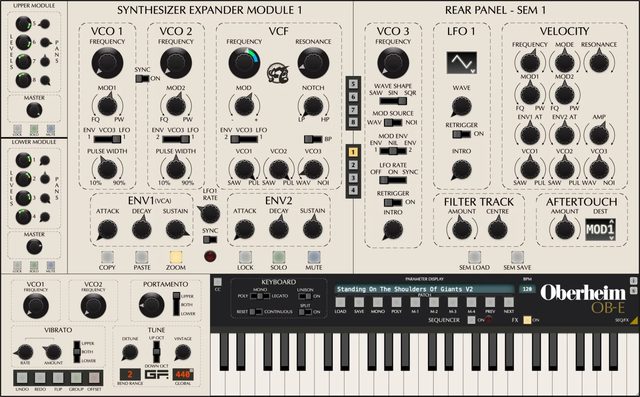
Developed by GForce Software, the "OB-E" is a massive software synthesizer that meticulously emulates the legendary "Oberheim 8-Voice" released in 1977. The biggest feature of this plugin is that it doesn't use a single synth engine but integrates "8 independent SEMs (Synthesizer Expander Modules)" into one screen. Furthermore, the fact that it is officially approved by the original creator, Tom Oberheim, speaks to its high quality. In this article, we place the utmost weight on evaluations from communities such as KVR Audio, Reddit, and YouTube, and review the true power of this monster synth.
1. Evaluation Trends Across Communities and Platforms
- Reddit (r/synthesizers, r/AudioPlugins) Discussions: On Reddit, its "overwhelming stereo width" is frequently praised. The massive synth brass and pads created by panning each of the 8 voices individually and applying subtle detuning are described as "impossible to replicate with any other VST." On the other hand, there are constant discussions about CPU load due to running 8 synths simultaneously.
- KVR Audio Forum Evaluation: "Finally Windows Support": Initially Mac-only at release, the KVR community rejoiced when the v2 update brought Windows support. Users concluded that "Arturia's OB-Xa V is also great, but in terms of pure analog rawness and organic instability, OB-E stands at the top."
- YouTube Reviews (Sonicstate, Starsky Carr, etc.): Prominent synth reviewers on YouTube focus on the "Vintage" knob and MPE support. The effect of the Vintage knob, which imparts random analog drift to all voices, and expressive playing using polyphonic aftertouch have garnered immense support from modern film music composers.
2. Main Modules and Architecture
| Module Type | Features and Community Evaluation |
|---|---|
| 8 Independent SEM Voices | Each voice has its own VCO, VCF, and envelope. You can choose to edit them individually or group them for unified control. |
| Continuously Variable Oscillator | Fully models the original SEM's behavior of seamlessly morphing from sawtooth to pulse wave (with PWM). |
| Multi-Mode Filter | A beautiful 12dB filter, synonymous with Oberheim, that sweeps smoothly from low-pass through notch to high-pass. |
| Vintage Control | With one button, it reproduces everything from a perfectly calibrated new state to the tuning instability characteristic of aged vintage units. |
3. Sound Quality: A Wall of "Authentic Oberheim Sound"
- Ultimate Stereo Spread: By panning each voice to L/R and slightly shifting attack times and filter cutoffs, you can achieve a vast, rich stereo field that exceeds the limits of your speakers.
- Iconic Brass and Pads: Synth brass reminiscent of Van Halen, which defined the 1980s, and thick synth basses like TOTO—these "era-defining thick sounds" are perfectly reproduced by the plugin alone.
4. Usability, CPU Load, and UI Challenges
- Overwhelming UI: With 8 synth panels (a huge number of knobs) on screen, beginners can easily feel visually overwhelmed. However, zoom functions and a link feature to control all voices at once make operation rational.
- High CPU Load: Literally processing "8 high-resolution analog modeling synths" simultaneously, the CPU burden when playing chords is very heavy. Even on multi-core PCs, running multiple instances later in a project requires careful management.
Pros and Cons Summary
Pros
- Absolute sound quality approved by Tom Oberheim.
- Ultimate stereo width and organic sound through individual control of 8 voices.
- High expressiveness with MPE and Vintage knob.
- Windows support and scalable UI in v2.
Cons
- UI design with too much information for beginners.
- Very high CPU load (when playing chords).
- Fine-tuning individual voices takes time.
Overall Review: The "King of Synths" That Breaks Through Sound Design Limits
The GForce Software OB-E is not for those seeking a lightweight, easy-to-use soft synth. As community evaluations prove, this is a top-tier tool for producers willing to invest PC power and programming time to achieve "the ultimate thick, most beautiful analog polyphonic sound." Whether for film music or authentic 80s synth-pop, if you want to give your tracks absolute conviction, the OB-E is undoubtedly the most powerful weapon that will meet your expectations.
[Tips] GForce Software OB-E: Sound Design to Unleash the 8 Souls (SEMs)
The GForce Software OB-E is a monster "8-voice polyphonic" synthesizer that bundles 8 independent Oberheim SEM modules into one. Rather than a simple polysynth, it exploits the unique hardware architecture of "playing 8 mono synths simultaneously." Here, we introduce maniacal tips that are trending in overseas communities.
1. Chaos Sequences Using "Round-Robin" Voice Assignment
The biggest feature of the OB-E is that when you play chords or run a sequencer, the SEM modules (1-8) that sound are switched one after another. * Arpeggios with 8 Different Timbres: Turn off Group mode, and set SEM1 as a kick, SEM2 as a noise snare, SEM3 as a metallic pluck, SEM4 as a deep bass, and so on, making all 8 completely different sounds. In this state, feed an 8th-note arpeggio or sequence from your DAW, and each key press will trigger a different SEM in succession, automatically generating complex, bizarre IDM-style polyrhythmic beats or West Coast modular-style sequences from just one MIDI track.
2. The Ultimate "Humanization" (Individual Differences) by Disabling Group Mode
The secret behind the overwhelming thickness of vintage analog lies in the subtle component degradation and tolerances of each voice card (circuit board). * Manual Component Modeling: First, turn on Group mode to edit all SEMs simultaneously and create a basic pad or brass sound. Then, turn off Group mode and intentionally shift the "VCO 2 detune," "VCF cutoff," and "envelope decay time" of each SEM slightly apart. This creates a far more vivid and thick "authentic vintage behavior" than typical built-in randomization features of plugins.
3. "Per-Voice Panning" That Tears the Stereo Field Apart
In the OB-E, each SEM module has an independent pan control. * Ultra-Spatial Chord Splitting: Hard-pan SEMs 1, 3, 5, 7 to the left (L) and SEMs 2, 4, 6, 8 to the right (R). Additionally, set the filter of the left-panned SEM group slightly darker and the right-panned group slightly brighter (or with subtle pitch detune). When you play chords, sounds with completely different harmonic structures fly from left and right with each keystroke, creating a cinematic pad with extraordinary width that envelops the entire mix without using chorus.
4. "Organic Breathing" with Independent LFOs per Voice
Typical polysynths modulate the whole sound with a global LFO, but the OB-E has completely independent LFOs for each SEM. * Asynchronous PWM (Pulse Width Modulation): Apply PWM to all 8 SEMs, but set the LFO rate of each SEM to slightly different values. When you hold a long chord, the 8 voices begin to swell at completely different cycles, producing organic strings that breathe deeply as if the sound itself has life, without relying on effects.
5. "Pitch Tearing" Effect with Individual Portamento (Glide)
In the OB-E, even the portamento time of each voice can be set individually. * Time-Staggered Glide Sweep: Set the Glide of SEMs 1 and 2 to "fast (short)" and SEMs 7 and 8 to "extremely slow (long)." When moving from a low chord to a high chord, some pitches arrive immediately while others slowly follow, recreating eerie, dramatic pitch sweep effects like the THX logo sound (deep note) in movie theaters, just by playing chords.