Reviews
Review: GForce Software Oddity3 - The "Ultimate ARP Odyssey" Emulation Enhanced with Modern Modulation
Rating: 4.7 / 5.0
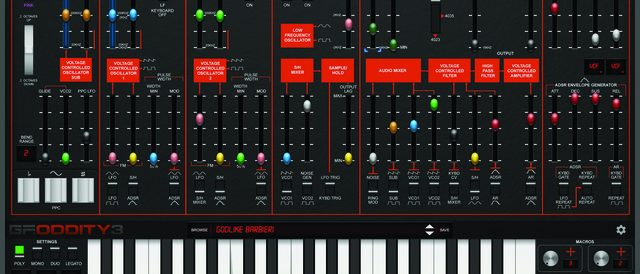
The "Oddity3" developed by GForce Software is the third generation of the highly acclaimed emulation of the legendary synthesizer "ARP Odyssey," famous for its piercing leads and fat basses. Version 3 elevates this classic into the modern production environment with a fully resizable UI, an advanced preset browser, and the integration of GForce's powerful "X-Modifiers." In this article, we review why this plugin reigns as the "definitive Odyssey emulation," placing the greatest weight on community feedback from KVR Audio, Reddit, and YouTube.
1. Evaluation Trends Across Communities and Platforms
- Comparative Discussions on KVR Audio Forum: The most frequent topic of discussion is the comparison with Korg's official ARP Odyssey plugin. The consensus on KVR overwhelmingly favors Oddity3, with users praising that "the UI and preset management are overwhelmingly superior" and "the raw oscillator sound and filter behavior feel fatter and more authentic."
- Discussions on Reddit (r/synthesizers, r/AudioPlugins): It is widely recognized as the "best ARP Odyssey plugin" on the market. Users particularly appreciate that all three historical filter revisions (Mk I, Mk II, Mk III) are included in one screen, describing it as extremely versatile, from smooth basses to screaming leads.
- YouTube Reviews (e.g., Starsky Carr): Prominent synth reviewers focus on the new macro controls and X-Modifiers. Demonstrations frequently show how adding subtle LFOs to oscillator sync and filter cutoff breathes organic, modular-like life into the simple duophonic synth.
2. Key Modules and Architecture
| Module Type | Features and Community Evaluation |
|---|---|
| Three Authentic Filters | Perfectly modeled 12dB Mk I, Moog-style 24dB Mk II, and screaming 24dB Mk III filters. Switch between eras with a single click. |
| X-Modifiers (XLFO / XADSR) | Apply dedicated modulation to almost any parameter without complex routing matrices. |
| Expanded Polyphony | The original was monophonic/duophonic, but Oddity3 offers full polyphony, allowing thick, brassy synth chords. |
| Effects & Macros | Gorgeous built-in distortion, delay, and matrix reverb, plus four macro knobs for expressive live manipulation. |
3. Sound Quality: Piercing Sync Leads and Heavy Basses
Summarizing community discussions, the sound is praised for its "aggressive and punchy" character.
- Ear-Piercing Hard Sync: Unlike Moog's round and warm sound, Oddity3 excels at ear-piercing hard sync leads and metallic FM-like textures.
- Tight Low End: Even when driving the Mk III filter, the low end remains surprisingly tight and punchy, making it popular for driving techno basslines and cinematic sequences.
4. Usability, CPU Load, and System Requirements
- Revamped UI and Browser: The newly resizable UI addresses the biggest complaint of Oddity2, making it perfectly usable even on 4K monitors. The tag-based preset browser is also incredibly fast and intuitive.
- Optimized Performance: Despite expanded polyphony and deep modulation, CPU load is surprisingly well-optimized, running smoothly even on older machines.
Pros and Cons Summary
Pros
- Definitive ARP Sound: Fat and authentic oscillators and filters that surpass competitors.
- Three Filter Models: All historical Odyssey revisions integrated into one unit.
- Powerful X-Modifiers: Provide endless modulation without patching.
- Excellent UI and Browser: Resizable and vastly improved sound management.
Cons
- Tendency to Be Too Aggressive: The aggressive ARP sound may not suit those seeking pure, warm Moog tones.
- Vintage-Heavy UI: Although resizable, it retains a vintage aesthetic with high information density that may seem cluttered to some modern producers.
Overall Verdict: The "Ultimate Odyssey" Unleashing the Essence of ARP in the Modern Era
GForce Software Oddity3 takes one of the most iconic synthesizers in history and perfectly adapts it to 21st-century workflows. As the community widely agrees, it completely surpasses competing emulations in both sound and usability. For producers needing aggressive leads, funky basses, and endless modulation, this is an absolute must-have.
Tips: Extreme Techniques to Expand the Legendary ARP Sound with GForce Software Oddity3
GForce Software Oddity3 is a monster plugin that fully recreates the iconic 70s ARP Odyssey while adding polyphony and its unique modulation mechanism, the "X-Modifier." Here are some maniacal tips practiced by overseas synth enthusiasts that break the limits of the hardware.
1. The "Demonic Fusion" of X-Modifier and Oscillator Sync
A hallmark of the ARP Odyssey is the "oscillator sync (VCO Sync)" that produces sharp, metallic harmonic changes, but in Oddity3 you can run wild with this via extended features. * Ultra-Fast Sync Sweeps: Sync Oscillator 2 to Oscillator 1. On the hardware, you would manually move the pitch slider or use a simple ADSR envelope, but assign Oddity3's unique "X-ADSR" or "X-LFO" to VCO2's pitch. By raising the X-LFO speed into the audible range (audio rate), you can generate vicious, complex harmonic sweeps (an evolution of wobble bass) used in dubstep, with speed and precision impossible on the hardware.
2. Dissonant Drones with Duophonic Mode and Ring Modulation
This technique exploits the ARP Odyssey's characteristic "duophonic (two-note poly)" behavior. * Metallic Drones That Change with Key Spacing: Set the voice mode to "Duo" and turn on the Ring Modulator. When you press two keys simultaneously, the lower note is automatically assigned to VCO1 and the higher note to VCO2. By varying the interval (pitch difference) between the two notes while playing, the non-integer harmonics from ring modulation change dramatically, creating atonal metallic drone sounds in real time—perfect for suspense film scores or industrial techno.
3. "Pseudo FM/AM" via Audio-Rate Modulation with X-LFO
Oddity3's extended LFO (X-LFO) can do more than just vibrato or wah-wah; it can modulate at ultra-high speeds. * Audio-Rate Modulation of VCA/VCF: Set the X-LFO Rate near maximum (audio rate) and apply it deeply to the VCA (amplifier) level or VCF (filter) cutoff. The fat ARP oscillator waveforms are chopped at high speed, adding "pseudo FM (frequency modulation)" or "AM (amplitude modulation)" characters not present on the hardware, allowing you to create cold bell sounds or noise bases that rival FM synths.
4. Dynamic Integration of Sample & Hold (S&H) and Velocity
Using the S&H mixer to create random pitch or filter changes (the so-called R2-D2-like sci-fi sounds) is an ARP staple, but in Oddity3 you can combine it with velocity. * Expressive Sci-Fi Effects: Set the S&H source to Noise and route it to VCO pitch or filter. Then assign "Velocity" to the modulation depth. When you play softly, you get a normal synth bass; when you play hard (with accent), the random S&H pitch changes run wild—creating a highly dynamic and playable sequence patch.
5. Alchemy of the Three-Generation Filters (Mk I, II, III) and Overdrive
Oddity3 lets you switch between the three historical Odyssey filters (Mk1: 12dB, Mk2: 24dB Moog-type, Mk3: 24dB ARP-type) with a single button. * Mk I Filter for Sub-Bass: When creating thick synth basses, many people tend to choose the 24dB filter, but deliberately select "Mk I (12dB/oct)". The Mk I filter has the characteristic that the low end doesn't drop out (doesn't thin out) even when resonance is raised. By adding a bit of Oddity3's built-in Distortion (Drive), you can build a ferocious analog bass that crawls along the ground without losing any bottom end.