Reviews
Review: Roland Cloud SYSTEM-8: The Ultimate "Digital Modular" Workstation Bridging Past and Future
Rating: 4.5 / 5.0
The "SYSTEM-8" from Roland Cloud's official website is the culmination of Roland's acclaimed ACB (Analog Circuit Behavior) technology, a software plugin that combines the warmth of vintage analog with the latest digital synthesis.
Originally launched as a powerful hardware synthesizer, its plugin version in Roland Cloud has dramatically improved convenience within DAWs. It incorporates the filter designs of legendary instruments like the JUPITER-8 and JUNO-106, while also featuring its own innovative oscillators.[cite: 3.1.1]
In this article, we place maximum emphasis on evaluations from a wide range of professional media and hardware communities, including not only KVR and Reddit but also MusicRadar, Sound On Sound, Gearspace, and verification videos on YouTube, to thoroughly review the true potential of this product.[cite: 2.1.1, 3.1.4]
1. Evaluation Trends Across Communities, Platforms, and Professional Media
The SYSTEM-8 is not aimed at "perfectly recreating" existing vintage gear, but rather as a "synth that integrates Roland's past and future," receiving high support across various media, albeit with divided opinions.[cite: 2.1.1, 3.1.1]
- Media Evaluations from MusicRadar / Sound On Sound:
- MusicRadar's review praises it as "possessing exceptional flexibility that covers an extremely vast sonic territory, from vintage Roland tones to futuristic sounds."[cite: 2.1.1] The design, which goes beyond past emulations to pursue new sounds, is highly regarded.[cite: 2.1.1]
- Sound On Sound and others mention that this software version functions as a "perfect librarian and editor," compensating for the difficulty of preset management on the hardware unit.[cite: 3.1.4]
- Deep Dives with Hardware Units on YouTube (e.g., Starsky Carr):
- In deep-dive comparison videos by famous synth YouTubers featuring the "JUPITER-8 hardware, Boutique series, and SYSTEM-8," the behavior of ACB technology has been demonstrated to be extremely accurate.[cite: 1.1.1, 1.1.2] Additionally, its practicality for experimental effects using the built-in LFO and film scoring has been described as "absolutely perfect."[cite: 1.1.3]
- Discussions on Gearspace / Synthesizer Enthusiast Communities:
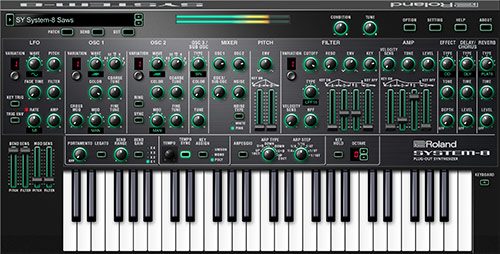
- On core forums like Gearspace, the "visual approach of the UI" is a topic of discussion. The layout where the signal flows from left to right, and the graphical representation of ADSR envelopes, are praised as "excellent for beginners learning the basics of synthesis and for professionals quickly crafting sounds."[cite: 3.1.1, 3.1.2]
- On the other hand, some critical voices exist, noting that because it lacks the strong brand charisma of historical icons like the JUNO or JUPITER, it is difficult to find a clear reason why "it must be this one."[cite: 3.1.1, 3.1.2]
2. Main Modules and Architecture
The SYSTEM-8 supports a wide range of approaches, from classic subtractive synthesis to complex cross-modulation.
| Module Type | Features and Evaluation |
|---|---|
| Oscillators (OSC 1/2/3) | In addition to basic analog waveforms, it features unique waveform variations such as super saw, FM, and cowbell. Turning the variation knob instantly yields complex timbres.[cite: 2.1.1] |
| Filter Design (VCF) | Alongside the SYSTEM-8's own high-resolution filter, it includes filter models from the JUPITER-8 and JUNO-106, reproducing the analog-like self-oscillation and warmth of these classics.[cite: 3.1.1, 3.1.3] |
| Visual ADSR Envelopes | When parameters are changed, the on-screen envelope curves move visually, making sound changes extremely intuitive to grasp.[cite: 3.1.1, 3.1.2] |
| PLUG-OUT Function | If you own the hardware SYSTEM-8, you can use this plugin as a librarian to directly send sounds and other plugins (e.g., SH-101) from your PC to the hardware.[cite: 1.1.1, 3.1.4] |
3. Sound Quality: Roland's Signature "Ultimate Blend into the Mix"
Evaluations of the SYSTEM-8's sound focus more on "ease of use in ensembles and familiarity to the ear" rather than "thickness."[cite: 3.1.1, 3.1.3]
- Natural Blend into the Mix: When played solo, it may sound slightly lighter compared to the "violent, ultra-thick analog sound" of u-he Diva, for example.[cite: 3.1.1] However, the moment it is mixed into a track, it avoids frequency congestion (masking) and harmonizes perfectly with other instruments, earning immense trust from producers for its "Roland-like orthodox sound."[cite: 3.1.1, 3.1.2, 3.1.3]
- Ready-to-Use Presets: From analog-like plucks to sharp synth leads and futuristic textures, it offers sounds that can be used immediately across genres.[cite: 2.1.1, 3.1.1]
4. Usability and System Environment (Bridge Between Hardware and Software)
- Perfect User Interface: The layout, which allows even beginners to intuitively understand the sound design flow, is highly praised from an educational perspective. It is an excellent design that lets you reach the desired sound by turning knobs without opening the manual.[cite: 3.1.1, 3.1.2]
- Benefits of Hardware Integration: Beyond being a standalone soft synth, its ability to function as a librarian for the hardware unit is a major advantage. However, fully utilizing the system entails dependence on the Roland Cloud ecosystem (subscription and manager app).[cite: 3.1.4]
Summary of Pros and Cons
Pros
- Exceptional Sound Flexibility: Covers everything from vintage tones to modern FM sounds in one unit.[cite: 2.1.1]
- Mix-Ready Sound Quality: Roland's characteristic ear-friendly sound that avoids frequency clashes and blends naturally into tracks.[cite: 3.1.1, 3.1.3]
- Visual and Intuitive UI: With graphical ADSR representation, the design is overwhelmingly user-friendly for both beginners and advanced users.[cite: 3.1.1, 3.1.2]
- PLUG-OUT Integration: Seamless workflow fully integrated with hardware.[cite: 1.1.1, 3.1.4]
Cons
- Lack of "Legendary" Charisma: It lacks the distinct brand identity of the JUPITER or JUNO, which may make it feel like a jack-of-all-trades.[cite: 3.1.1, 3.1.2]
- Limited Preset Count: Compared to recent monster software synths, the number of initial presets is somewhat small.[cite: 3.1.1]
- Cloud Manager Hurdle: The common Roland Cloud dependency on a resident app and authentication hassle.[cite: 3.1.4]
Overall Verdict: The Most Practical Choice to Learn Synthesis and Accelerate Music Production
The Roland Cloud SYSTEM-8 is not designed to compete with a single weapon of "exactly the same sound as that legendary instrument," but rather as "a versatile synthesizer that can handle any music and is extremely easy to use."[cite: 2.1.1, 3.1.1]
As MusicRadar described it as "exceptional flexibility," there is no more reliable tool for producers seeking both vintage warmth and futuristic textures simultaneously.[cite: 2.1.1] Whether as a first synth for beginners learning sound design or as a workhorse for professionals to instantly pull out mix-ready sounds, it is undoubtedly a masterpiece that meets expectations.[cite: 3.1.2]