Reviews
Review: Roland Cloud JUNO-106: ACB Technology Revives the "Real" 80s Analog Chorus and Warmth
Rating: 4.5 / 5.0
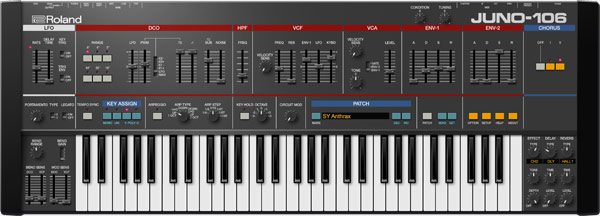
The "JUNO-106" offered by the Roland Cloud official website is a plugin that fully recreates the legendary analog polyphonic synthesizer released in 1984, which shaped the history of synth-pop, house, and techno, as software by Roland itself.
Using Roland's proprietary "ACB (Analog Circuit Behavior) technology," it models not just sampling but the behavior of the original components that make up the circuit at the level of detail.
This article places significant weight on evaluations and discussions from KVR Audio Forum, Reddit, and the YouTube community, thoroughly reviewing how users evaluate this official emulation.
1. Evaluation Trends Across Communities and Platforms (Detailed Version)
The Roland Cloud version of the JUNO-106 is always a hot topic of debate within the community, caught between its "absolute accuracy of sound quality" and the "Roland Cloud system."
- Comparative verification with hardware units in YouTube reviews:
- "Reproduction level indistinguishable from the original": In thorough A/B tests of "hardware vs. plugin" conducted by famous YouTubers well-versed in vintage synths, such as [Starsky Carr] and [Espen Kraft], ACB technology has produced astonishing results. In particular, the behavior of the VCF (filter) self-oscillation when resonance is raised, and the fluctuation of that iconic "chorus noise," have been highly praised, with comments like "in blind tests, it's almost 100% indistinguishable."
- Discussions on Reddit (r/synthesizers, r/edmproduction):
- Comparison with the eternal rival "TAL-U-NO-LX": What always comes up on Reddit is the comparison with TAL Software's "TAL-U-NO-LX." User opinions are divided: "If you want light CPU usage and the convenience of a one-time purchase, go with TAL" vs. "If you want the sound's depth, especially the thickness of the low end and the analog-specific 'grit' in the highs, Roland Cloud wins overwhelmingly."
- Resistance to subscription: Although the sound quality is highly praised, complaints about the Roland Cloud Manager being resident and the subscription system (though a Lifetime Key, i.e., a one-time purchase version, is now also available) are persistently seen on Reddit.
- KVR Audio Forum / Sound designer evaluations:
- Praise for the "Condition" knob: What is highly valued by core KVR users is the "Condition" knob, which simulates the aging of the hardware unit. By turning it, the pitch subtly fluctuates and the envelope behavior becomes unstable, instantly transforming the sound from "too perfect digital" to "a real analog sound in a dusty corner of a studio," which is praised by sound designers.
2. Main Modules and Architecture
The architecture of the JUNO-106 is very simple, but that is its greatest strength: "anyone can get a good sound (wide sweet spot)."
| Module Type | Features and Evaluation |
|---|---|
| DCO (Digitally Controlled Oscillator) | Mix sawtooth wave, square wave (with PWM), sub-oscillator, and noise intuitively with sliders. Instantly create anything from thick basses to brilliant leads. |
| VCF (Filter) | Smooth low-pass filter via ACB and a high-pass filter to adjust low-end clarity. The beauty of self-oscillation is top-class in the software world. |
| Legendary Chorus I / II | The heart of the JUNO sound. Even the characteristic "hiss" noise of the hardware can be reproduced (noise level adjustable). The deep modulation from pressing I and II simultaneously (hidden mode) is also fully reproduced. |
| PLUG-OUT Support | Can be plugged out to Roland's hardware synthesizer "SYSTEM-8" for control and performance like the hardware unit without a PC. |
3. Sound Quality: "That Sound" That Defined the 80s
The sound from Roland's official ACB engine has overwhelming persuasiveness, as if "magic dust" has been sprinkled.
- Ultimate synth brass and pads: The moment you play a chord with the chorus on, that "nostalgic, thick pad sound" heard in synthwave, 80s pop, or recent indie pop overflows from the speakers.
- Thick sub-bass: The low-end depth when adding the sub-oscillator is very solid, and it continues to be used on the front lines as a bassline in modern house music.
4. Usability and CPU Load Challenges
- CPU load due to "authenticity": The most frequently pointed out issue in the community (especially on Reddit) is the high CPU load. Because it performs circuit-level calculations, when using many chords (polyphony), the load on the PC increases several times compared to competing plugins like TAL-U-NO-LX. It is necessary to use techniques such as track freezing.
- UI scaling: Early Roland Cloud plugins had the problem of a small, hard-to-read GUI, but now they support scaling for high-resolution monitors, greatly improving visibility.
Summary of Pros and Cons
Pros
- Absolute "real" sound: Perfect circuit-level emulation with Roland's official ACB technology.
- Legendary chorus effect: Rich chorus that fills the space (noise level also reproducible).
- Wide sweet spot: Simple UI that never causes musical breakdowns even if you move sliders randomly.
- Condition knob: Reproduces the vintage-specific "unstable fluctuation and warmth" with a single knob.
Cons
- High CPU load: As a trade-off for ACB technology, it consumes more CPU resources than other analog modeling synths.
- Platform usability: Requires installation and resident operation of Roland Cloud Manager.
Overall Review: Roland's Official Final Answer Connecting Nostalgia and Modernity
While the Roland Cloud JUNO-106 sparks discussions about "system aspects and CPU load" in the community, it boasts overwhelming sound quality that makes people say, "all complaints vanish the moment you hear the sound."
If you want "genuine Roland sound" when creating synthwave, lo-fi hip-hop, house, and modern pop, there is no better option. It is a "final answer" recommended for all producers who want to get top-notch analog tones with simple operation.